Founder story / ShipFast · TrustMRR · DataFast
MarcLou
ShipFast Made Marc Lou Over $1M. Last Month It Made $3,537
Portfolio shipping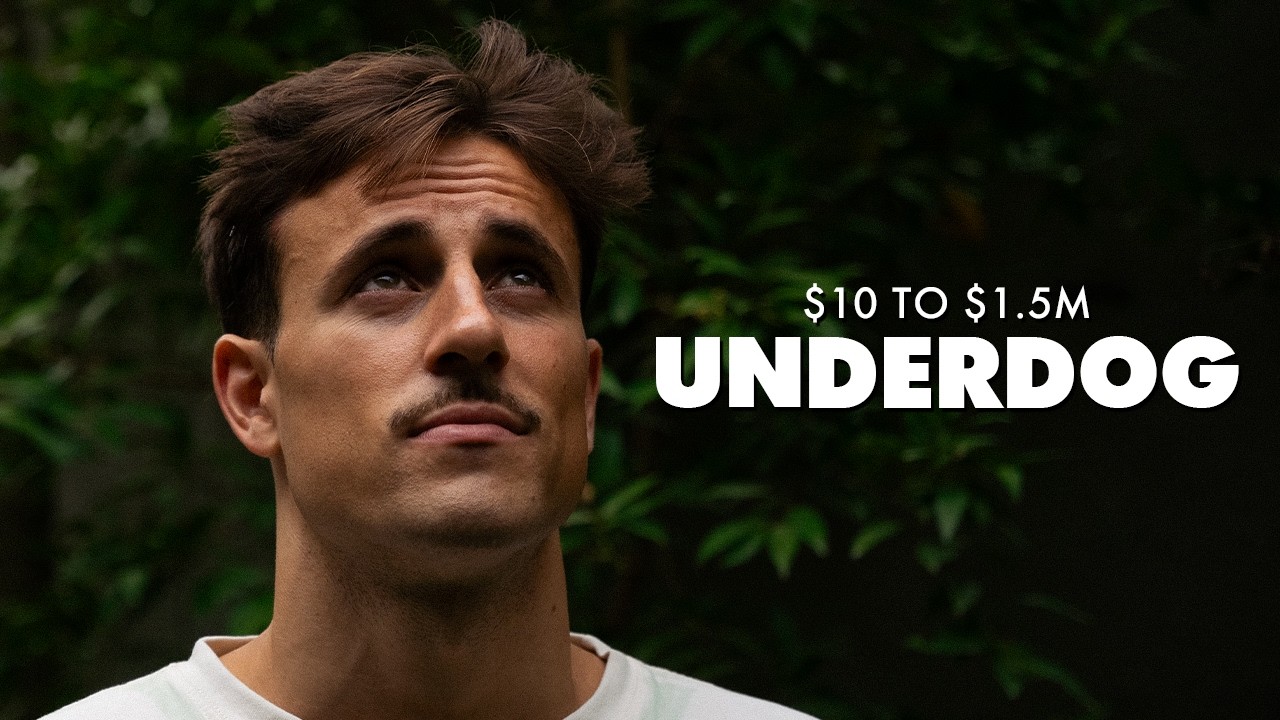
The story in one line
The product that made him famous is now 3% of his business.From a $2 PDF advertised on QR stickers in Paris public toilets to a $2.9M Stripe-verified portfolio, this is the dated record of ShipFast’s 84% decline and the products he shipped to replace it.
A $2 PDF about dribbling, and the wall he punched
“I thought I’d build something clever: The Golden Plumber. A $2 PDF to help men stop dribbling after peeing. Yes, really. I even printed stickers with QR codes and stuck them in public toilets in Paris, hoping strangers would buy it. Nobody did.”
That is Marc Lou, writing in his October 2025 newsletter about the year he was “broke, 27, living with my wife in my parents’ house in Paris, still trying to prove I wasn’t a failure.” In an earlier telling he put a number on the PDF: “I created an info-product (2-page PDF) and ran ads on adult websites. I made $8 in 2 months. I quit, again.”
He dates the floor precisely. “On Wednesday 9th, June 2021, while drinking a morning coffee in my bedroom, I started to cry. Sadness turned to anger and dug 4 holes in the wall.”
The wall was not the end of it. He got depressed, quit entrepreneurship, and took a job as a product manager for Tai Lopez, “to overcome my depression,” he wrote later. “It worked because I finally had a sense of purpose. When I got fired in November 2021, it didn’t matter. I had a dream.” His current homepage compresses the whole period into six words: “I was fired everywhere, so I hired myself.”
What changed after the firing was not effort. It was scope. On Twitter he discovered the build-in-public community and named his role models, and the debt is published on one of their websites. His testimonial on Pieter Levels’s book site reads: “readMAKE 📚 by @levelsio was the tipping point of my entrepreneurship journey. ❌ 1 year to build big startups in the dark ✅ 1 month to launch a small project in public.” There is a direct line from the Pieter Levels edition to this one: Levels built in public and published his numbers. Marc Lou adopted the method. He would eventually build a business out of enforcing it.
The failure count became the signature. His YouTube channel description is one sentence: “I was fired everywhere so I built 27 startups.” On camera for Starter Story he puts it as arithmetic: about 35 startups shipped, roughly 30 of which “are nothing,” for a hit rate of about 5 percent.
Twenty-seven months after the four holes in the wall, the five percent landed.
The version of the story that made him famous
The wave
On September 1, 2023, he launched a Next.js starter kit called ShipFast. “I told my wife we’d be lucky if we made $100 with it. By the end of the month, ShipFast made $40,000.”
The timing was close to perfect. Next.js was ascendant, the starter-kit category was thin, and AI-assisted building had not yet made a competing boilerplate a weekend project. And the launch did not land cold: by September 2023 he had spent nearly two years building in public, with an audience already primed to buy from him. His X bio had doubled as a live revenue ticker since late August 2023, and in the earliest archived capture it read “⚡️ ShipFa.st $9k/mo.” A year later the same bio read “$62K/m.”
Describing what a viral YouTube feature did to sales, he said on camera that ShipFast went “from like $50,000 a month to somewhere around $85,000 on the first month then 135 in the second month 135 in the third month,” before “slowing down a little bit to somewhere like around $80,000 a month.” The number that travelled furthest came from Noah Kagan, who profiled him in June 2024: “last month, he made $143,280 as a solopreneur working from Bali.” That was Marc Lou’s own figure, given to Kagan, and it covered his whole portfolio, worth knowing when you meet it on a page with no date attached. Product Hunt named him Maker of the Year. By December 2023 he had published the story under its own headline, $0 to $65,000 a month in two years, and reported selling two side projects along the way: an AI landing page generator for $35,000, a habit tracker for $10,000.
The price of the boilerplate ratcheted upward the whole way. It launched at $49 and $69. “Maybe 50 or 60 dollars,” as he put it in a French interview, and the launch-day archive backs him. Three years later the same offers read $169 and $199. The scarcity counter ratcheted with it: “$60 off for the first 110 customers (15 left)” on launch day, “$100 off for the first 8400 customers ( 13 left)” today. The number left has been in the low double digits for three years.
Then, in October 2024, the criticism stopped being about taste.
On October 18, a developer posting as Simon raised server-side validation problems in ShipFast; Indie Hackers reported that one of those posts reached 11 million views. Over the following days a second developer described getting past the paywall in under five minutes and reported exposed user data. His first response, three days later, was not an apology. He announced he had started blocking people and wrote that his feed “is made of developers who think the world can be fixed with more tests.” The defections came from friendly quarters. Aaron Francis, posting the same day: “it does seem like people are surfacing legit vulnerabilities (like… getting free access to the thing?) and you’re just writing them off as yappers.” Pieter Levels posted his own security practice as an implicit contrast.
On October 24 he apologised. “Shipping fast does not mean shipping irresponsibly,” he wrote, then unblocked everyone, and spent the following weeks fixing and testing. Levels called it “an exceptional recovery.” One developer replied that the timing suggested he had “started seeing the impact on your earnings.” The question nobody answered belongs to the people who paid: ShipFast is a copy-and-paste code repository, not a hosted service, so buyers who had shipped the vulnerable code had it running on their own servers. Whether those customers received the fixes is asked repeatedly in the comments and answered nowhere in any source we retrieved.
The security week was the visible turn. The invisible one had already started.
The number nobody updated
Search today for how much ShipFast makes and you will be told $528,000, or $250,000 in five months, or $50,000 a month, or $141,000 in monthly recurring revenue. That last one is impossible by construction: ShipFast is a one-time purchase, so its recurring revenue is zero and always has been.
Here is the actual monthly record, taken from the Stripe-connected timeline on his own dashboard.
| Month | ShipFast | CodeFast | DataFast | TrustMRR |
|---|---|---|---|---|
| Sep 2025 | $13,999 | $14,780 | $8,424 | launched, no revenue yet |
| Dec 2025 | $20,281 | $22,267 | $16,187 | $22,883 |
| Mar 2026 | $9,463 | $8,268 | $21,306 | $31,921 |
| Jun 2026 | $3,338 | $9,788 | $21,487 | $28,603 |
| Jul 2026 | $4,832 | $6,682 | $27,158 | $42,373 |
Read the first column downward: down about 84 percent in half a year, and that from a plateau already far below the months he described on camera. Measured against those, the fall is closer to 97 percent. In the thirty days before August 11, 2026, ShipFast took $3,537: his fifth-largest product, sixth if you count that X’s creator payouts pay him more than his boilerplate does. Read the last two columns downward and you get the answer to what replaced it.
His own ticker tells the same story, in his own numbers, archived by a third party the whole way: “$9k/mo” in September 2023, “$62K/m” in August 2024, “$4K/m” today. A roughly 94 percent fall, self-published.
The live sales page has not changed to match. It still advertises “8387 makers built AI tools, SaaS”. Neither has the internet. The stale numbers sit above the current one in the search results, and the one page carrying the current figure is his own dashboard.
The decline itself is not a scandal. A one-time-purchase product has a shape: a launch wave, a long tail fed by the founder’s audience, then decay as the content ages and the category fills in. ShipFast is a clean instance of the shape. What makes it worth a feature is the sequencing: the decline was predictable, he appears to have priced it in, and the replacement was shipped and growing before the old line went flat.
It also answers the charge that has followed him longest. On Hacker News in January 2024, in the words people actually use: “It’s definitely grifty… It reminds me of people who sell classes using tales of their success, except all of their success comes from selling the classes in the first place.” In 2024 the complaint had real force: the boilerplate and the course were almost all of the money. The dated record is what answers it: by August 2026 most of his income comes from DataFast and TrustMRR: an ordinary analytics SaaS and a verification dashboard, products that teach nobody how to get rich. That is not a defence anyone offered on his behalf. It is what the numbers he publishes happen to show.
He owns the scoreboard
His own page leads with $108k a month. His own dashboard puts his true recurring revenue at $43,817. Both were read the same day and both are true, because they measure different things: most of that $108k is one-time revenue that has to be re-sold every month, and only three products carry actual subscriptions.
The shape is deliberate, and he told Greg Isenberg why: “what I do is I tend to remove any subscription and I really ask myself do I need that subscriptions,” citing a friend’s rule that “if you have a recurring payment you should provide recurring value.” His stated reason is conversion: “when you see a subscription you’re already thinking what happens if I have to cancel.” It is a defensible product principle, argued on its merits. The side effect is that the headline number on his own page ends up being the one that flatters him most.
Where he explains why he removes subscriptions
| Product | Last 30 days | All-time | Recurring? |
|---|---|---|---|
| TrustMRR | $38,705 | $281,755 | Yes, $17,537 MRR across 13 subscriptions |
| Ship or Die | $32,456 | $108,911 | No, one-time |
| DataFast | $26,569 | $245,386 | Yes, $26,245 MRR across 1,264 subscriptions |
| CodeFast | $5,954 | $821,211 | No, one-time |
| ShipFast | $3,537 | $1,267,263 | No, one-time |
| IndiePage | $695 | $50,805 | No, one-time |
Every figure in that table rests on TrustMRR. Marc Lou built TrustMRR. It is currently his largest source of revenue.
That disclosure sits at the center of this story rather than in a footnote, because the loop is the story. Describing the product’s origin on camera, he says the idea came from a Pieter Levels post about people faking their revenue, and that he thought: “what if I make a little little board that showcase you know all the verified revenues of all those people so we can see who’s a scammer and who’s telling the truth.” So the sequence runs: a man becomes famous publishing large revenue numbers, the community starts arguing about whether such numbers are real, and he ships the arbiter. It now out-earns the product that made him famous by a factor of eleven. “I built this side project in 24 hours,” he wrote of it, “and a few days later it was at $25K MRR.”
The figures themselves hold up better than you might expect from a man grading his own homework. His Stripe data flows through a live API connection rather than screenshots, a higher standard of evidence than anything else available about him, and his self-reported monthly income posts, checked line by line against those timelines, match to within rounding in every month but one. The exceptions and the open questions live in the evidence notes at the bottom of this page, including the one gap he never explains: his two own dashboards disagree about ShipFast’s lifetime total by $179,335, between two Stripe-fed properties he operates.
Owning the scoreboard has one more return: he now holds data on the indie acquisition market that nobody else has, and in July 2026 he gave it away on the French podcast Sans Permission. There had been 115 acquisitions completed on the platform. The largest deal ever done through it was, in his words, “just under 100,000.” And the folklore multiple is wrong: “Generally in SaaS you’d say between 3 and 5. Here it’s 1.5.” He also said he turned down $1,000,000 for TrustMRR itself. Read that against our Jack Friks edition: both cofounders of Ship or Die were offered a million for their main product and both said no. Friks then listed Post Bridge at a 9.1x multiple, priced by the one man in the story with the data to know how unusual that is.
From selling code to selling consequences
In May 2026 he launched Ship or Die with Jack Friks. You pay once, join, and ship a working product within 30 days. If you miss, you are removed permanently with no refund. The site does not soften it: “Miss the deadline… and you’re out,” it reads, listing what you lose. “Hall of shame in the public Discord channel ✕ Kicked out of the community ✕ Publicly marked overboard ✕ No refund.”
The crew page reports 369 people shipping and 50 thrown overboard, an elimination rate of about 12 percent of everyone who has ever joined, and the most concrete number the company publishes. In its third full month it became his second-largest product. Stripe is a named sponsor, and every member receives $250 in Stripe fee credits: a payments company underwriting an indie-hacker accountability club. A sequel, Marketing or Die, is already live at the same domain with the same elimination mechanic applied to marketing.
The relationship with Friks did not start as a partnership. Friks is the lead testimonial on the ShipFast homepage: “Without ShipFast I might have never launched my SaaS and I would still be at $0 MRR.” Customer, then testimonial, then cofounder.
Look at what he sold in each phase and the trajectory is one long move up the value chain of other people’s intentions. ShipFast sold the code. CodeFast sold the skill. DataFast sold the measurement. TrustMRR sold the proof. Ship or Die sells the consequence for not doing it. Each product is further from the work itself and closer to the reason the work does not get done, and the revenue has followed in that order.
Cyprus, with the ticker still running
He left Bali quietly. “I moved the startup office to Cyprus,” he posted in February 2026, citing 12.5% corporate tax and 0% capital gains; his March newsletter repeated it in four words. Asked directly on Sans Permission that July whether he still lives in Bali, he answered: “Uh, Cyprus, but we’re in Korea half the year.” His own homepage still displayed Bali a month later.
In January he had totted up the year from Crete, house-hunting: “I earned 20% less in 2025 than in 2024, but I wouldn’t change anything.” The cost of the method, he publishes too: “I work all days all year long… I don’t like Sundays because my fun is actually making stuff.”
Somewhere between Limassol and Seoul, a man who once stuck QR-code stickers in Paris toilets is watching other founders’ revenue flow through his dashboard, deciding nothing, verifying everything. The bio ticker is still running. It reads $4K/m where it once read $62K. He is the one who left it that way, because the number underneath it, the one the ticker was always really advertising, is doing fine.
The 60-second summary
The pattern in one sentence: the product that made his name became a rounding error inside his own business within three years, and the thing that replaced it is a tool that checks whether other founders are telling the truth about their revenue.
The playbook, if you want it. Ship at a rate that makes any single failure cheap. His own hit rate is about 5 percent, and he treats that as the design. Protect one long block of making time; he starts the day offline, four to six hours building before the support inbox exists. Let each product sell the next: free tools promote paid ones, and “I started to make fun launch videos. People enjoyed and shared them, creating a viral loop.” And publish your numbers before anyone asks. That is the Levels inheritance, the part that compounds, because every subsequent launch arrives with a checkable track record attached.
What you cannot copy. The audience came first: 370,503 followers on X against 192 in the April 2022 archive, built across two years before ShipFast ever launched. The timing, a thin category at the exact ascendancy of Next.js, is gone. The failure years were genuinely bad and are not a growth hack; nothing in the record suggests he enjoyed them. And the flywheel is now partly self-referential: his largest product verifies revenue claims in a community where he is one of the most-watched claimants. That position took the audience to build and cannot be bought.
The dated record, end to end
The first dollar, then COVID
VirallyBot, described on his own site as “My first $1 online. It’s a SaaS that reached $4K MRR ($80,000 total revenue) but was rekt by COVID”. His own Stripe record for it shows $67,843 all-time.
Bali becomes home
“After making my first $1 online in 2018, my Korean girlfriend and I had no reason to stay in Seoul anymore… So we moved to Bali in September.” This is the date that reconciles his later accounts: “six years” in March 2024 and “seven years” in January 2026 are the same claim.
Rock bottom in his parents’ house
Broke at 27 in Paris. The Golden Plumber made $8 in two months. “I started to cry. Sadness turned to anger and dug 4 holes in the wall.”
Fired by Tai Lopez
“When I got fired in November 2021, it didn’t matter. I had a dream.” He discovers the build-in-public community on Twitter and names Pieter Levels and Danny Postma as his role models.
ShipFast launches
$40,000 in the first month against an expectation of $100. The first archived capture of shipfa.st is dated 25 August 2023, a week before launch, and the launch-day capture prices it at $49.
$65,400 a month
He publishes the $0 to $65,000/month story, and reports two exits along the way: “I sold my AI landing page generator for $35,000 and my habit tracker for $10,000.”
The framing objection
On Hacker News, a reader objects to the monthly framing of one-time sales: “you keep referring to the income brought in by ShipFa.st … as ‘51K/m’ (as of today this is what your X’s bio shows), when pricing is obviously not recurring.”
Product Hunt Maker of the Year
“Today I received the Product Hunt’s Maker of the Year 2024 award.” Arvid Kahl had already introduced him with the title in March 2024; the year is genuinely disputed across sources, so we quote his own words.
The security week
Public bug reports about ShipFast reach millions of views. He blocks people, then fixes the paywall, then apologises. “Shipping fast does not mean shipping irresponsibly.”
CodeFast, DataFast, and the course war
The coding course takes about $100,000 in two days. Its launch draws public criticism from founder Arib Khan. DataFast already exists by this point, making around $1,000 a month, which is part of what the argument was about.
TrustMRR, built in a day
“I built this side project in 24 hours, and a few days later it was at $25K MRR.” Its first recorded month is October 2025 at $7,887. The acquisitions marketplace follows within months.
$1,032,000 in 2025, and a plan to leave Bali
“I earned 20% less in 2025 than in 2024, but I wouldn’t change anything.” He writes it from Crete, house-hunting.
Out of Asia
“I moved the startup office to Cyprus,” citing 12.5% corporate tax and 0% capital gains.
Ship or Die, cofounded with Jack Friks
Ship in 30 days or be removed permanently, no refund. Sponsored by Stripe.
Cyprus, and Korea half the year
Asked directly on Sans Permission whether he still lives in Bali: “Uh, Cyprus, but we’re in Korea half the year.”
The current shape
TrustMRR and Ship or Die lead the trailing thirty days. ShipFast is his fifth-largest tracked product, sixth by his own June 2026 accounting, because his Twitter creator payouts pay him more than his boilerplate does.
Sources and evidence notes
How this edition was reported. Every dashboard number was fetched on August 12, 2026 from the machine-readable TrustMRR profiles, which carry their own Stripe sync timestamps; every figure is stamped to the sync of August 11. We re-fetched immediately before publishing on August 13 and the counters had moved (ShipFast’s trailing thirty days from $3,537 to $3,836, on a sync stamped 2026-08-13T02:00:19Z); we have not restated the edition around the newer numbers, because a dated snapshot you can check beats a moving one you cannot. Monthly timelines are only publicly exposed for a rolling twelve-month window, so this edition makes no monthly claims before August 2025. Two internal checks on the dashboard data: summing the 17 individual all-time figures on his founder profile reproduces the displayed total to within one dollar, and the per-product last-thirty-day numbers on marclou.com mirror the TrustMRR Stripe numbers to within a few hundred dollars on every line, meaning his personal site is a rounded mirror of the same data, not a second source. There is one source here, and he owns it. His self-reported monthly income posts, checked line by line against his own Stripe timelines across November 2025 to February 2026, match to within rounding with a single meaningful exception, noted below.
What we could not verify
- Which year he won Product Hunt Maker of the Year. His own tweet says 2024, Arvid Kahl introduced him with the title in March 2024, and his site carries it undated. The Product Hunt hall-of-fame page sits behind a Cloudflare challenge and could not be fetched on August 12, 2026, so we quote his own words rather than pick a year.
- Whether existing ShipFast buyers received the October 2024 security fixes. Asked repeatedly in the Indie Hackers comments, unanswered in every source retrieved. The sales page advertises lifetime updates, and the All-in tier displays “Updated 6 months ago,” which is context rather than an answer. This is the sharpest open question in the record.
- The ShipFast and CodeFast lifetime totals. TrustMRR says ShipFast has taken $1,267,263 and his own page says $1,087,928, a gap of $179,335, or 14 percent. On CodeFast the gap runs the other way: $839,025 on his page against $821,211 on TrustMRR. Both are Stripe-fed properties he operates and he explains neither. We say “more than a million” for ShipFast throughout and attribute every figure to the dashboard it came from.
- His own headline monthly figure, one year apart. The Wayback capture of marclou.com dated 4 January 2025 displays $182.1k a month, with CodeFast alone at $136.4k a month. His newsletter of 4 January 2026 reports $1,032,000 for calendar 2025, an average nearer $86k a month. A single $182.1k month is not impossible inside that year, since CodeFast had launched weeks earlier with a large one-time cohort, but he does not say so, and we have not assumed it.
- February 2026, TrustMRR. The single meaningful exception in the line-by-line check: he posted $33.3k against a Stripe timeline showing $30,842, an overstatement of about 8 percent, on the one product whose dashboard he controls.
- The VirallyBot lifetime total. Three first-party figures exist: $80,000 on his site today, $70,000 in his December 2023 newsletter, and $67,843 on his own Stripe record. We cite the Stripe figure.
- The startup count. 27 in the line he repeats most often, 30 in the October 2025 newsletter, about 35 on camera for Starter Story, 36 named properties on his own page, 17 carrying Stripe-verified revenue on his founder profile. Five different definitions rather than a contradiction; we use the verified count wherever a number has to do real work.
- Net worth. No credible public figure exists, and we did not produce one. On the record: his January 2026 newsletter discloses $15,000 a week into the S&P 500, returning $147,000. Searches for this frequently return results about Marc Lore, a different person.
- French-language business press. His two most detailed interviews are in French, yet fifteen French-language searches across the major French tech and business outlets on August 13, 2026 found no article naming him. Several titles (Les Echos, Capital, BFM, Le Figaro) block our crawler, so for those we could only search the open web. A French founder clearing seven figures alone, unwritten about at home, is the shape of the finding, not proof that nothing exists.
A note on the French interview. Source 19 is a two-hour conversation conducted in French on 5 July 2026, the newest and most detailed interview he has given. It is the source for his current country, the TrustMRR acquisition data, and the refused $1,000,000 offer. Those passages are quoted in our own translation from the French auto-captions, and the French originals are held in our research file alongside each translation. Because auto-captions do not carry speaker labels and the episode has two hosts, we have used only passages where Marc Lou is unambiguously the speaker.
A note on quotations from video. The Starter Story material and the Greg Isenberg conversation are quoted from auto-generated captions, which are unpunctuated and contain recognition errors. Where the captions drop a word the sense requires, we have supplied it in square brackets rather than inside the quotation marks. Readers should treat exact phrasing in those passages as approximate. Where a figure mattered, we took it from the Stripe-connected record instead of the transcript.
Relationship disclosure. TrustMRR, the source of the revenue data throughout this edition, is a product owned and operated by Marc Lou, the subject of this edition. It is currently his largest single source of revenue. The same disclosure appears on our Jack Friks edition, where the dashboard is built by an associate of the subject; here it is built by the subject.
- TrustMRR founder profile, Stripe-connected, fetched 12 August 2026.
- TrustMRR, ShipFast profile, the source of the $1,267,263 and $3,537 figures.
- marclou.com, his own Indie Page, fetched 12 August 2026.
- “My solopreneur story: $0 to $65,000/month in 2 years”, 23 December 2023.
- “I’ve been a loser most of my life”, 11 October 2025, the source of the Golden Plumber passage.
- “I made $1,032,000 in 2025”, 4 January 2026.
- Starter Story, “How I Work: $77K/Month Solopreneur”, auto-generated captions.
- Starter Story, “The Underdog: From $10/hr to $1.5M/Year”, 5 August 2024.
- The Bootstrapped Founder, episode 300, Arvid Kahl, 6 March 2024, official transcript.
- shipfa.st, live pricing and customer counter, fetched 12 August 2026.
- ship-or-die.com, mechanics and pricing, fetched 12 August 2026.
- TrustMRR, DataFast profile.
- TrustMRR, Ship or Die profile.
- The Startup Ideas Podcast, Greg Isenberg, 11 September 2024.
- readmake.com, carrying his testimonial to Pieter Levels.
- Indie Hackers, “Security bugs engulf ShipFast”, Stephen Flanders, 23 October 2024.
- Indie Hackers, “Marc Lou issues an apology for ShipFast bugs”, 25 October 2024.
- Indie Hackers, “Course war: Marc Lou’s $100K success sparks a SaaS founder’s criticism”, 3 December 2024.
- Sans Permission, “35 startups solo, un million par an, zéro employé”, Antoine Blanco and Oussama Ammar, 5 July 2026, in French.
- Melvynx, ShipFast interview in French, the source of the “maybe 50 or 60 dollars” launch price.
- Hacker News, 8 January 2024, the objection to monthly framing of one-time sales.
- x.com/marclou, 3 January 2025, the year-by-year revenue ladder.
- Wayback Machine capture of shipfa.st, 1 September 2023, launch day, the source of the original $49 and $69 offers.
- “Solopreneur Rollercoaster: from $1 to overcoming depression”, 16 December 2023, the source of the Bali move, the $8 PDF and the morning he punched the wall.
- x.com/marclou, 5 February 2026, announcing the move of the startup office to Cyprus.
- “I grew a SaaS to $1M”, 10 March 2026, the newsletter in which he says he moved to Cyprus.
- x.com/marc_louvion, May 2024, his own statement of the Product Hunt award.
- Noah Kagan, profile of Marc Louvion, 5 June 2024, the source of the $143,280 month.
- Hacker News, 18 January 2024, the second of the recurring “grift” threads.
- Wayback Machine capture of his X profile, 30 August 2024, the bio reading “ShipFa.st $62K/m”.
- His YouTube channel, read 12 August 2026, the source of the channel description and the subscriber and video counts.
- His live X profile, read 12 August 2026, the source of the follower count and the current bio ticker. He posted as @marc_louvion until 21 November 2025 and as @marclou since, which is why both handles appear in these sources.
- x.com/marclou, June 2026, the income breakdown in which Twitter creator payouts rank above ShipFast.
- x.com/marc_louvion, 21 October 2024, his first response to the security reports. The Aaron Francis post quoted beside it is dated the same day and the Pieter Levels post referred to is dated 22 October 2024; both were captured during our reading of that week’s discussion, and we could not retrieve a stable public permalink for either, so we date them rather than link them.
- ship-or-die.com/crew, the public crew page, fetched 12 August 2026, the source of the 369 shipping and 50 overboard figures.
- ship-or-die.com/marketing, Marketing or Die, fetched 12 August 2026.
- Wayback Machine capture of his X profile, 4 September 2023, the bio reading “ShipFa.st $9k/mo”.
- Wayback Machine capture of his X profile, 9 April 2022, the 192-follower reading.
- Wayback Machine capture of marclou.com, 4 January 2025, displaying $182.1k a month with CodeFast at $136.4k a month.